

Something must have angered the spirits in the Cholame Valley on September 28, 2004. That is how native peoples would have viewed the 6.0 magnitude Parkfield Earthquake. It caused no injuries and little damage, but provided a bounty of scientific data, and as such might be the first earthquake ever perceived as good news.
Earthquakes had occurred in the same segment of the San Andreas Fault in 1857, 1881, 1901, 1922, 1934, and 1966. Geologists saw a consistent pattern, so they rigged the area with sensors, some buried 1,000 feet down. They hoped to learn something the next time the fault ruptured, and they did.
Their sensors detected that the Pacific Plate moved south, not north as is the general trend, suggesting that lateral faults like the San Andreas move back and forth. Second, equipment detected nothing before the earthquake struck, so early warning systems might not be effective. Finally, with the addition of 2004 to the sequence, the temporal distribution—intervals of 24, 20, 21, 12, 33, and 38 years—is looking less linear and more cyclical. Or, maybe there's no pattern after all.
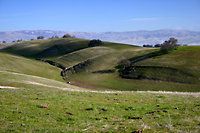
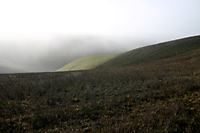
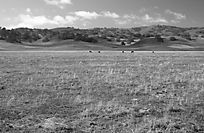
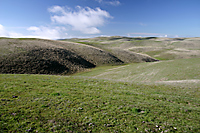
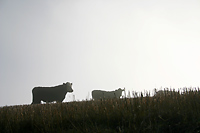
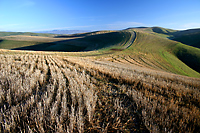
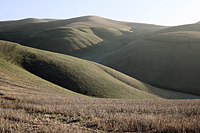
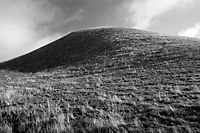
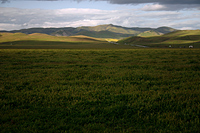
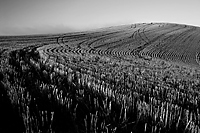
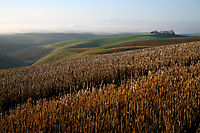
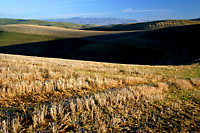
Most of these pictures were taken earlier in 2004, about five miles south of the earthquake's epicenter. I'm drawn to this region for the landscapes—described by John Muir as possessing "curves and slopes of inimitable beauty"—that result from thirty million years of grinding between two chunks of Earth's solid crust.
More on the Parkfield 2004 Earthquake: San Francisco Chronicle, Geotimes, ScienceDaily.
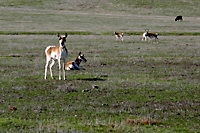
California's Central Valley was once North America's most productive habitat for the pronghorn (Antilocapra americana). They have now been reintroduced to remote Earthquake Country.
Ian McMillan (1905-1991) was a locally-grown naturalist who wrote on condors, coyotes, pesticides, and off-road recreation.
Screen painter Eyvind Earle (1916-2000) captured the Coast Range aesthetic like no one else.
